Design Partner Program — Limited to 20 Teams
Stop planning around battery counts. Start planning around the mission.
A rugged, portable charging system for drone teams operating away from fixed infrastructure. Solar, vehicle, internal battery — designed to keep your fleet flying through a full deployment.
Request Pilot Access20 teams. No purchase required.
Drone teams still plan around power, not the mission.
The aircraft keep getting better. The ground support hasn't caught up. Every team we talk to describes the same set of workarounds — and the same costs.
Battery math limits every mission
30-45 minutes per battery. Multi-hour missions require 8-12+ packs per aircraft — and no way to recharge on site.
Improvised charging setups
Vehicle inverters, power strips, portable generators. None of them are designed for drone batteries. Most risk damaging them.
Generators create new problems
Weight, noise, fumes, fuel logistics. Especially problematic for public safety, SAR, and operations near populated areas.
Downtime kills coverage
Every return trip to a vehicle or staging area means lost flight time, repositioning, and gaps in mission coverage.
Why this problem matters now.
The gap between drone capability and field support is widening. Teams are absorbing the cost in downtime, spare batteries, and operational compromises.
Drone deployments are scaling faster than support infrastructure
Inspection, emergency response, and survey teams are flying more sorties in more locations — but field logistics haven't changed in years.
Missions are moving further from fixed power
Remote infrastructure corridors, wildfire zones, disaster sites. The operating radius is growing, but charging still requires a return to base.
Battery diversity is increasing
Teams operate mixed fleets — DJI, Skydio, custom platforms. Mixed fleets create charging and battery-management complexity that most existing solutions were not designed to solve.
What we're building.
A self-contained, portable field power system purpose-built for drone battery charging in austere and remote environments.
Multi-battery charging
Designed to charge multiple drone batteries simultaneously using modular, platform-specific adapters.
Solar + internal battery
Onboard energy storage with solar input support. Extend your operational window without a generator or grid connection.
Vehicle charging input
12V/24V vehicle integration under development. Charge the system from your truck, UTV, or field vehicle while in transit.
Continuous rotation
Charge batteries while you fly. Designed for hot-swap workflows that minimize downtime between sorties.
Modular battery adapters
Initial development focused on DJI Matrice and Mavic series. Adapter architecture designed to support additional platforms based on operator feedback.
Rugged field deployment
Ruggedized case designed for transport in vehicles, aircraft cargo, and field staging areas. Targeting rapid setup and teardown.
This is not a consumer power bank or a repurposed portable battery. It's being designed from the ground up for the specific demands of professional drone operations.
System architecture.
The OpVolt Field Power System integrates energy storage, charge management, and multiple power inputs into a single deployable unit. Architecture is being refined through operator feedback.
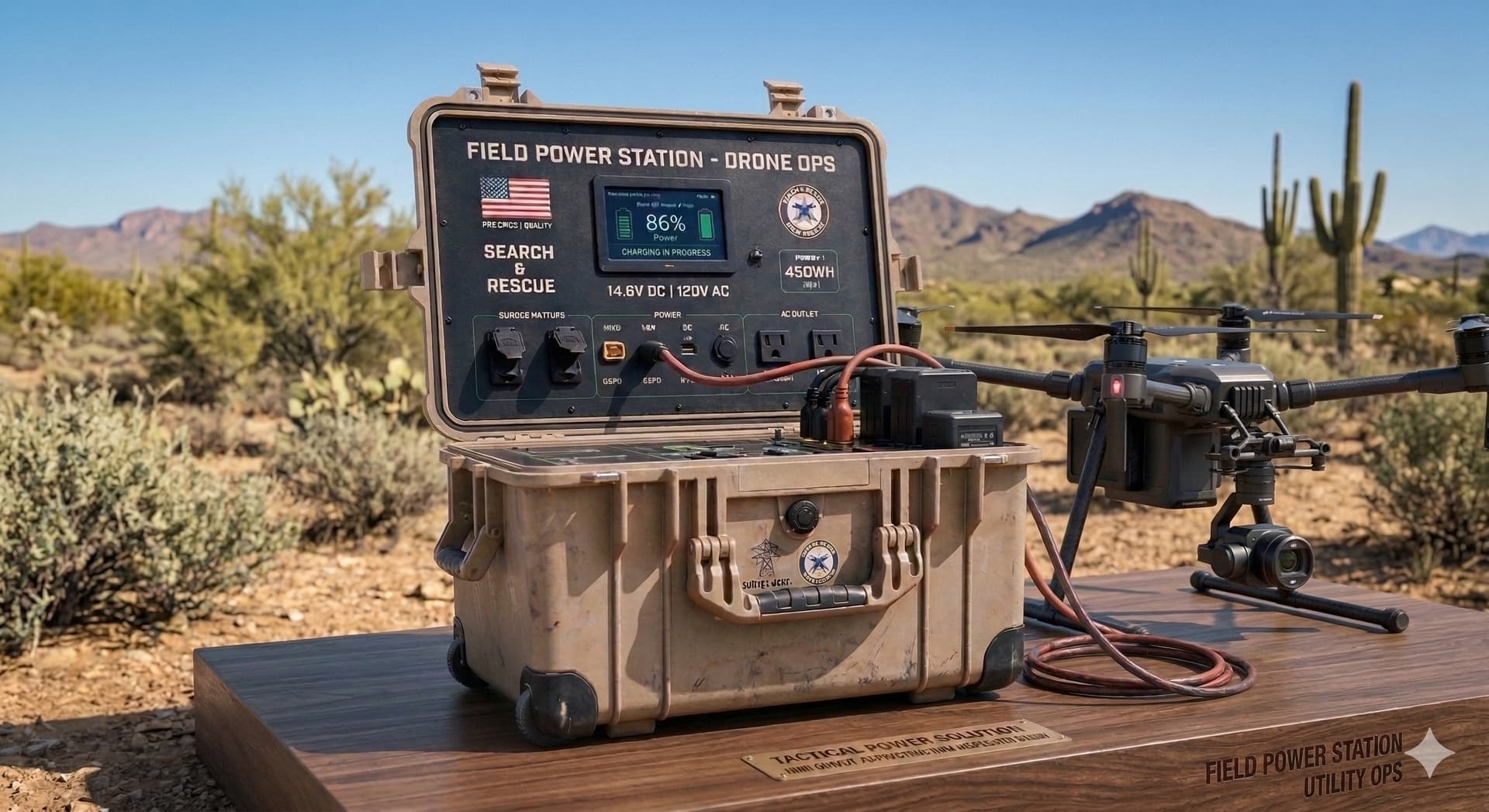
Product concept visualization. Final design informed by design partner feedback. Additional concept and prototype materials available to qualified design partners.
Design Targets
All specifications are design targets under active development. Final specs will be shaped by design partner input and prototype testing.
Who we're building this for.
We're focused on teams running recurring field deployments where battery logistics are a persistent operational constraint.
Primary Focus
Utility & Infrastructure Inspection
Powerline patrols, pipeline surveys, bridge and tower inspections. Multi-hour missions across remote corridors with no grid access.
Primary Focus
Public Safety & Emergency Response
Search and rescue, wildfire mapping, disaster assessment. Unpredictable mission duration where sustained coverage is critical.
Energy & Renewables
Solar farm inspection, wind turbine surveys, transmission infrastructure. Large-area coverage in remote sites.
Industrial & Construction
Site mapping, progress monitoring, volumetric surveys. Repeat deployments on active job sites far from permanent power.
Designed around real field deployment problems.
This product didn't start with a spec sheet. It started with conversations — through interviews with inspection, survey, and emergency-response teams managing recurring field deployments and the battery logistics that come with them.
Every team describes the same friction: mission planning driven by battery counts instead of operational requirements. Improvised charging setups that risk damaging expensive batteries. Generators that add weight, noise, and complexity to deployments that are already logistically difficult.
We're building OpVolt because this problem is common, costly, and unaddressed by existing products. And we're building it in direct partnership with the operators who face it.
We're still learning. Your input shapes what we build.
We're actively interviewing drone teams to understand how battery logistics and field power affect real operations. If your team deploys regularly, your experience is directly relevant.
We want to hear from you if your team deals with:
- Managing battery inventory for multi-hour field deployments
- Transporting generators or improvised charging setups to remote sites
- Losing flight hours to charging downtime between sorties
- Operating mixed drone fleets with incompatible battery systems
- Planning missions around power constraints rather than operational needs
Even if you're not interested in the product, your operational experience helps us build something that actually works.
Design Partner Program
We're selecting up to 20 professional drone teams to work with us from prototype through production. This is not a waitlist — it's an active collaboration.
Shape the product
Your operational requirements directly inform engineering priorities, feature sequencing, and platform support.
Prototype access
Qualified teams will be offered pre-production units for field evaluation. Your feedback determines what ships.
Preferred pricing
Design partners receive preferred pricing on first production units as a direct result of their contribution.
Direct engineering access
Ongoing communication with the engineering team throughout development. Not a support ticket — a working relationship.
Who we're looking for: Teams with recurring field deployments, active UAS programs, and a willingness to test early hardware and share candid feedback. We prioritize utility/infrastructure inspection and public safety teams.
Request pilot access.
Tell us about your team and your field operations. We're prioritizing teams with recurring deployments and active battery logistics challenges.
Limited to 20 design partner teams.